
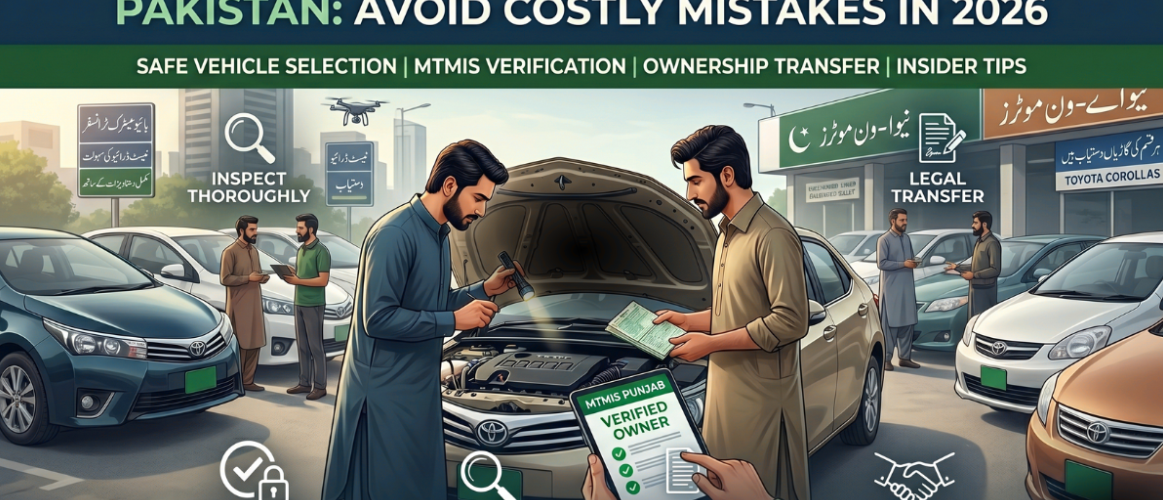
Buying a used car in Pakistan is one of the biggest financial decisions most families make, yet most buyers rush into it with minimal preparation. The Pakistani used car market has exploded in recent years, especially with imported vehicles now comprising 20% of the market (up from 7.5% in 2020). This surge has created both opportunity and risk. Buyers who know how to navigate the market safely can find incredible value. Those who skip verification steps lose thousands.
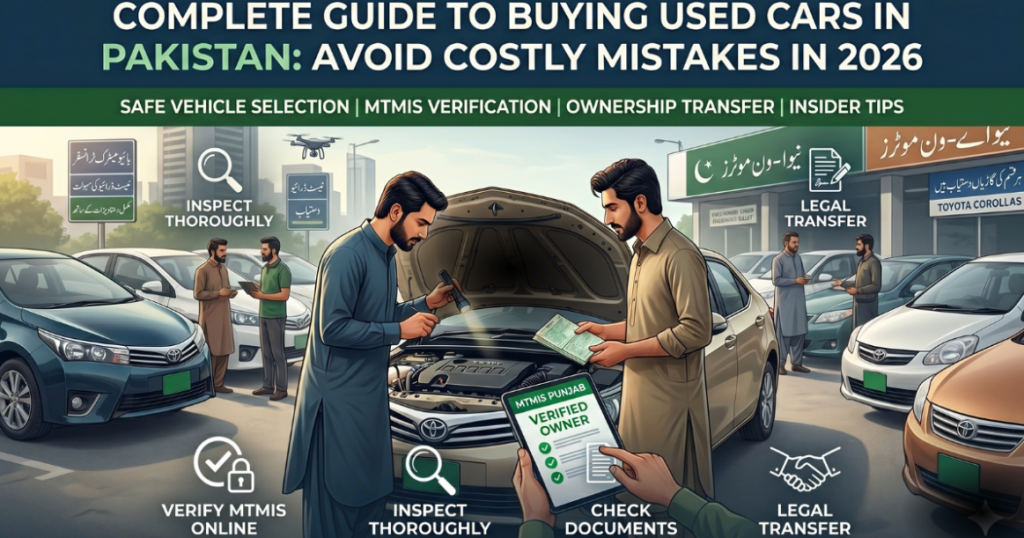
This guide walks you through every step of buying a used car in Pakistan, from setting realistic budgets to completing legal ownership transfers. More importantly, it teaches you how to spot red flags that most first-time buyers miss.
Step 1: Define Your Budget With Actual Numbers
Most Pakistani buyers begin by asking, “What’s the average used car price?” That’s the wrong starting question. You should instead ask: “What’s my actual budget?” and then work backward.
Your budget must include:
- Vehicle purchase price (the number you see in advertisements)
- Transfer fees (approximately 2,000-5,000 PKR depending on vehicle value)
- Token tax (annual vehicle tax, varies by engine size)
- Registration transfer costs (typically 1,000-3,000 PKR)
- Immediate maintenance (budget 15-20% extra for repairs discovered post-purchase)
- Insurance (varies by vehicle type, starting ~3,000 PKR monthly)
Real example: A buyer finds a Toyota Corolla 2015 listed at 1.8 million PKR. They think this is their budget. In reality, they need an additional 300,000-400,000 PKR for all additional costs. Their true budget must be 2.1-2.2 million PKR.
Most buyers discover this gap too late, after purchasing a vehicle they can’t afford to properly register or maintain.
Step 2: Research Vehicle Reliability and Resale Value
Not all cars are created equal in the Pakistani market. According to PakWheels’ 2025 data, the most searched used vehicles are:
- 1. Toyota Corolla (58+ million searches) – Legendary reliability, spare parts everywhere
- 2. Honda City (1.69 crore searches) – Affordable sedan entry point
- 3. Suzuki Alto (highest searches among budget segment) – Unbeatable fuel economy
- 4. Suzuki Cultus – Practical family car, excellent value
- 5. Honda Civic – Premium sedan choice
Why does this matter? When you buy a vehicle with strong market demand, you protect your investment. If circumstances change and you need to sell, these vehicles resell quickly with minimal loss.
Compare this to buying a niche brand with weak resale value. You might save 200,000 PKR by buying a less popular model, but lose 400,000 PKR when you eventually need to sell.
Step 3: Verify Vehicle Ownership and Details Before Meeting the Seller
This is the critical step most Pakistani buyers skip, and it’s exactly where fraud happens.
Before you even contact the seller, verify the vehicle using MTMIS Punjab (Motor Transport Management Information System). If the vehicle is registered in Punjab, you can check:
- Real owner name and CNIC
- Vehicle registration status
- Token tax payment history
- Any pending traffic violations
- Vehicle authenticity (matching chassis and engine numbers)
How to access MTMIS Punjab:
- Visit the official MTMIS portal
- Enter the vehicle registration number
- Instant results confirm if the vehicle is legitimate
You can also use alternative platforms for vehicle verification, including SMS services and provincial Excise & Taxation portals for Sindh, Islamabad, and KPK.
This single step prevents 90% of used car purchase problems. Buyers who skip this often discover months later that they purchased a stolen vehicle, a vehicle with duplicate registration, or a car with undisclosed accident damage linked to the original owner.
Step 4: Inspect the Vehicle Thoroughly in Person
Once online verification confirms legitimacy, schedule an in-person inspection. Don’t rely on
photographs or the seller’s description.
Check exterior condition:
- Compare paint color in direct sunlight. Mismatched panels indicate accident repairs orrepainting.
- Look for rust, especially around the wheel wells and undercarriage
- Examine all panels for alignment. Gaps between the door and frame indicate collisiondamage.
- Check that all lights (headlights, brake lights, turn signals) function.
Check interior:
- Test all electronic features: window switches, seat adjustments, air conditioning, heating
- Inspect seat condition for tears, burns, or excessive wear
- Check steering for looseness or abnormal noise
- Verify odometer reading (look for signs of tampering or rollback)
Check mechanical components:
- Belt and hose condition
- Fluid leaks under the engine
- Tire tread and condition
- Brake responsiveness during test drive
During the test drive:
- Listen for unusual sounds (grinding, knocking, squealing)
- Feel for vibration or pulling to one side
- Test braking distance and smoothness
- Verify transmission shifts smoothly
- Check that warning lights don’t illuminate
A 30-minute thorough inspection catches 80% of mechanical problems. A superficial inspection misses critical issues that cost 50,000-200,000 PKR to repair.
Step 5: Verify Documents Match Physical Vehicle
After you’ve confirmed online ownership and inspected the vehicle, match the physical documents:
- Chassis number (on engine block and in registration book) must match
- The engine number must match the registration
- The registration book should be original, not a photocopy
- Color, make, and model in documents must match the actual vehicle
- Seller’s CNIC in registration must belong to the person you’re negotiating with.
Discrepancies here signal potential fraud. For example, if the registration shows a silver Corolla but you’re looking at a white one, the vehicle has been repainted (often to conceal accident damage).
Step 6: Complete Legal Ownership Transfer
After agreeing on the price, complete the ownership transfer immediately. This requires:
- Both buyer and seller present with original CNICs
- Original registration book
- Completed transfer forms from the Excise & Taxation department
- Biometric verification (now required in most provinces)
- Transfer fee payment (usually 2,000-5,000 PKR)
- Token tax updated in the buyer’s name
The transfer process typically takes 7-15 days. Many buyers skip this step, thinking it’s optional, then discover months later that they have no legal claim to the vehicle because registration remains in the seller’s name.
Red Flags That Signal Avoid the Sale
- Seller unwilling to verify vehicle online – Massive red flag indicating potential fraud
- Chassis or engine numbers don’t match documents – Vehicle may be stolen or haveduplicate registration
- Mismatched paint – Indicates accident repairs not disclosed
- Odometer shows unrealistically low mileage – Likely rolled back (odometer tamperingis common)
- Seller doesn’t have the original registration book – Difficult to prove ownership legally
- Multiple transfer stamps in registration within a short period – Vehicle changedhands repeatedly (why?)
- Outstanding token tax or e-challans – You inherit these penalties even if you buy thevehicle
- Seller claims “transfer is your problem after purchase” – Legitimate sellers help withthe process
Final Checklist Before Handing Over Money
- ✓ Verified ownership online using MTMIS or provincial portal
- ✓ Physical inspection completed with no red flags
- ✓ Documents match vehicle (chassis, engine, color)
- ✓ Original registration book in seller’s hands
- ✓ Seller has original CNIC matching registration
- ✓ Vehicle has no outstanding token tax or fines
- ✓ Price agreed upon and deposit documented
- ✓ Appointment scheduled for ownership transfer
Don’t skip this checklist. These steps take 2-3 hours total but prevent 50,000-2,000,000 PKR in losses.
Conclusion
Buying a used car in Pakistan in 2026 is safer and more transparent than ever, thanks to systems like MTMIS Punjab and improved vehicle verification platforms. However, safety depends entirely on whether buyers actually use these tools.
The most expensive regrets come not from paying slightly higher prices, but from purchasing fraudulent vehicles, stolen vehicles, or cars with undisclosed damage. Every hour you invest in verification pays dividends in long-term ownership satisfaction and financial protection.
Start your next used car purchase by verifying ownership online. Then proceed with the confidence that you’ve done your due diligence.


Post a Comment